Spelling Bees of Special Interest
Here are details on several interesting puzzles in Spelling Bee history.
If you cite information from any LexiConnexxions report, please give credit and a link to the relevant page. These reports and analyses are compiled and prepared by a person, not a machine. Thank you.
Spelling Bee of 2026-08-19: First Spelling Bee to Include Both E and R
The Spelling Bee of August 19, 2026, was the first Spelling Bee ever to include both E and R in the letter set: V E L N O P R
The exclusion of E+R has long puzzled Bee solvers, especially as E+D and I+N+G are present in a significant proportion of all Spelling Bees (16.71% and 17.25% of all Bees in 2025, respectively as detailed HERE).
This first use of E+R in the Bee allowed for many new words to be added to the Bee lexicon: 28, or 68% of the total solution set. (In the three “S” Bees, new words comprised 56%, 63%, and 93% of the solution sets, as detailed HERE.)
As he did with those S puzzles, Bee editor Sam Ezersky did a fine job selecting a reasonable pangram and choosing a center letter (V) that kept it all in order. Contrary to what Bee solvers might have expected (or feared), the solution set did not include any adverbs or adjectives that used the comparative suffix -ER.
Over the past year and more, as LexiConnexxions has recorded and reported 1) the significant decline in the rate at which new words are added to the Bee, and 2) a significant increase in the recycling of pangrams, we have suggested that the use of S and E+R would keep things fresh. This E+R Bee of August 19, and the three “S” Bees, demonstrate that it is possible to use these letters to produce entertaining, solvable Spelling Bees.
The exclusion of E+R has long puzzled Bee solvers, especially as E+D and I+N+G are present in a significant proportion of all Spelling Bees (16.71% and 17.25% of all Bees in 2025, respectively as detailed HERE).
This first use of E+R in the Bee allowed for many new words to be added to the Bee lexicon: 28, or 68% of the total solution set. (In the three “S” Bees, new words comprised 56%, 63%, and 93% of the solution sets, as detailed HERE.)
As he did with those S puzzles, Bee editor Sam Ezersky did a fine job selecting a reasonable pangram and choosing a center letter (V) that kept it all in order. Contrary to what Bee solvers might have expected (or feared), the solution set did not include any adverbs or adjectives that used the comparative suffix -ER.
Over the past year and more, as LexiConnexxions has recorded and reported 1) the significant decline in the rate at which new words are added to the Bee, and 2) a significant increase in the recycling of pangrams, we have suggested that the use of S and E+R would keep things fresh. This E+R Bee of August 19, and the three “S” Bees, demonstrate that it is possible to use these letters to produce entertaining, solvable Spelling Bees.
Spelling Bee of 2025-06-06: Game Word Spelled out in Grid and 2LL
On June 6, 2025, attentive Bee solvers who checked the official Spelling Bee Hints for the day’s Spelling Bee found that the grid and two-letter list spelled out one of the day’s words, AGLOW.
This happened purely by chance.
The grid presents data about the numbers of words and the lengths of all the words in the day’s puzzle. The two-letter list (2LL) shows the numbers of words that begin with the same first two letters. The list always has one line for each of the letters used to begin words. In both of these displays, the information is always arranged with the starting letters in alphabetical order.
The grid and 2LL for the Bee of June 6, 2025 show that the solution set included words beginning with only five of the seven letters. And when those five letters are arranged in alphabetical order, they spell AGLOW, which was a word in the solution set for that day.
This happened purely by chance.
The grid presents data about the numbers of words and the lengths of all the words in the day’s puzzle. The two-letter list (2LL) shows the numbers of words that begin with the same first two letters. The list always has one line for each of the letters used to begin words. In both of these displays, the information is always arranged with the starting letters in alphabetical order.
The grid and 2LL for the Bee of June 6, 2025 show that the solution set included words beginning with only five of the seven letters. And when those five letters are arranged in alphabetical order, they spell AGLOW, which was a word in the solution set for that day.
Spelling Bee of 2025-04-01: April Fool’s Day Edition
On April Fool’s Day 2025, the Spelling Bee editor pranked the solving community with a clever trick.
About three quarters of all Spelling Bees are repeats of earlier puzzles, using recycled letter sets and pangrams, though with different center letters, thus yielding unique (albeit similar) puzzles. (LexiConnexxions tracks these on a monthly and annual basis, as reported HERE.)
Most players don't notice this repetition because the related puzzles are typically separated by a year or more. (Only very rarely have there been actual duplicate Bees, as reported HERE.)
About three quarters of all Spelling Bees are repeats of earlier puzzles, using recycled letter sets and pangrams, though with different center letters, thus yielding unique (albeit similar) puzzles. (LexiConnexxions tracks these on a monthly and annual basis, as reported HERE.)
Most players don't notice this repetition because the related puzzles are typically separated by a year or more. (Only very rarely have there been actual duplicate Bees, as reported HERE.)

On April 1, 2025, however, the Bee used the same letter set and pangram (ECHOING) that had been used in the Bee just a few days earlier, on March 30. The joke, of course, was the meta pun riffing on the meaning of the pangram, which implies an almost exact duplication or return of something. And in retrospect, the pangram on March 31, COMEBACK, was a clue to the repetition on April 1.
Sharp-eyed players who reached Genius level noticed that Beeatrice had donned a new chapeau for the occasion, as shown at right. (See a collection of Beeatrice’s different looks HERE.)
Sharp-eyed players who reached Genius level noticed that Beeatrice had donned a new chapeau for the occasion, as shown at right. (See a collection of Beeatrice’s different looks HERE.)
Spelling Bee of 2024-08-11: Pangram Spelled Out on the Official Hints Page
On August 11, 2024, Bee solvers who checked the official Spelling Bee Hints for the day’s Spelling Bee found an unusual sight.
The letter set array spelled out one of the day’s pangrams, BACKLOT. (The other pangram was BOOTBLACK.)
This was the first time that this had happened in Bee history.
The letter set array on the Hints page is always formatted in the same way: Center letter (in bold), followed by the other six letters in alphabetical order. The information on the Hint page conformed exactly to this pattern; it just happened to spell out one of the pangrams.
This was the first time that this had happened in Bee history.
The letter set array on the Hints page is always formatted in the same way: Center letter (in bold), followed by the other six letters in alphabetical order. The information on the Hint page conformed exactly to this pattern; it just happened to spell out one of the pangrams.
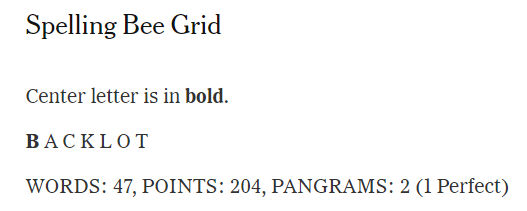
Once in a great while, the letter set array hints strongly at the pangram, as in these examples:
CHIKORY (pangram HICKORY) September 29 2020 LADNRUY (pangram LAUNDRY) November 6 2021 ACHNOVY (pangram ANCHOVY) February 3 2022 FACILTY (pangram FACILITY) June 29 2022
There are very few like these in Bee history, perhaps a half dozen, but not until the Bee of August 11, 2024 had a full pangram been perfectly spelled out in the letter set array.
CHIKORY (pangram HICKORY) September 29 2020 LADNRUY (pangram LAUNDRY) November 6 2021 ACHNOVY (pangram ANCHOVY) February 3 2022 FACILTY (pangram FACILITY) June 29 2022
There are very few like these in Bee history, perhaps a half dozen, but not until the Bee of August 11, 2024 had a full pangram been perfectly spelled out in the letter set array.
Spelling Bee of 2024-08-09: Center letter Z and just 16 words
With center letter Z and just 16 words, the Spelling Bee puzzle of 2024-08-09 was among the most interesting in Bee history. Here’s why:
1 – Rare use of center letter Z: The Spelling Bee of August 9, 2024 marked just the 6th time that Z had been selected as the center letter. (The last time was on November 5, 2022.) By contrast, the most frequently-used center letters (O, A, L, and T) have been used about 200 times each.
2 – One of the shortest Bee puzzles: The Bee of August 9, 2024 was one of the two shortest ever, having only 16 words. Only one other Bee has had so few words (March 27, 2023). So, this Bee ties for first place, in terms of fewest words. Most Spelling Bees have, on average, 40-45 words.
3 – One of the longest Bee words: The longest word in this puzzle(ANTAGONZING) was 12 letters long; it is one of just 42 12-letter words in the Bee lexicon of nearly 10,300 words. Only nine Bee words have 13 or more letters; thus, the 12-letter word in this puzzle tied (as of this date) for 10th place in terms of word length.
1 – Rare use of center letter Z: The Spelling Bee of August 9, 2024 marked just the 6th time that Z had been selected as the center letter. (The last time was on November 5, 2022.) By contrast, the most frequently-used center letters (O, A, L, and T) have been used about 200 times each.
2 – One of the shortest Bee puzzles: The Bee of August 9, 2024 was one of the two shortest ever, having only 16 words. Only one other Bee has had so few words (March 27, 2023). So, this Bee ties for first place, in terms of fewest words. Most Spelling Bees have, on average, 40-45 words.
3 – One of the longest Bee words: The longest word in this puzzle(ANTAGONZING) was 12 letters long; it is one of just 42 12-letter words in the Bee lexicon of nearly 10,300 words. Only nine Bee words have 13 or more letters; thus, the 12-letter word in this puzzle tied (as of this date) for 10th place in terms of word length.
SOLUTION SET 2024-08-09
AGONIZINGANTAGONIZINGGAZING GONZOIONIZATIONIONIZINGOOZINGZAGGING
ZIGGINGZIGZAGZIGZAGGINGZINGZINGINGZINNIAZITIZONING
Spelling Bee of 2024-07-04: Center letter J and just 18 words
With center letter J and just 18 words, the Spelling Bee puzzle of 2024-07-04 was among the most interesting in Bee history. Here’s why:
1 – One of the shortest Bee puzzles: This puzzle was among the shortest of Spelling Bees ever. Of the 2,255 Bees that had been offered as of July 4, 2024, there had been only one Bee with 16 words, two with 17 words, and six with 18 words, including the Bee of July 4. (Most Bees have, on average, 40-45 words.)
2 – First time for center letter J: This puzzle was the first time in Spelling Bee history that J had been selected as the center letter.
3 – Unique solution set: All the words in the solution set (shown below) started with the same letter (J) and that one letter was also the center letter (J). This may have been the only time in Bee history that this set of conditions coincided.
4 – More than half the solution set were new words: Ten new words made their Spelling Bee débuts on July 4, which meant that more than half the words in the solution set (10 of 18) were new. The ten new words, all of which began with J, increased the number of Bee words that begin with J from 59 to 69, an instant increase of 17%.
1 – One of the shortest Bee puzzles: This puzzle was among the shortest of Spelling Bees ever. Of the 2,255 Bees that had been offered as of July 4, 2024, there had been only one Bee with 16 words, two with 17 words, and six with 18 words, including the Bee of July 4. (Most Bees have, on average, 40-45 words.)
2 – First time for center letter J: This puzzle was the first time in Spelling Bee history that J had been selected as the center letter.
3 – Unique solution set: All the words in the solution set (shown below) started with the same letter (J) and that one letter was also the center letter (J). This may have been the only time in Bee history that this set of conditions coincided.
4 – More than half the solution set were new words: Ten new words made their Spelling Bee débuts on July 4, which meant that more than half the words in the solution set (10 of 18) were new. The ten new words, all of which began with J, increased the number of Bee words that begin with J from 59 to 69, an instant increase of 17%.
SOLUTION SET 2024-07-04
JIGGINGJIGGLINGJIGGLYJIGGYJILLIONJINGLINGJINGLYJINGOJINN
JINNIJOGGINGJOGGLINGJOINJOININGJOLLILYJOLLYJOLLYINGJOYING
Spelling Bee of 2024-03-25: The solution word "BINGO" was spelled out on the official Hints page
The Spelling Bee of March 25, 2024 was unique for a very interesting reason.
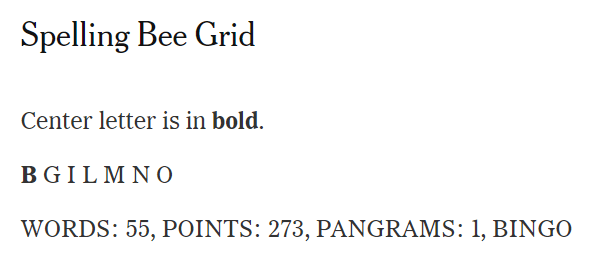
In Spelling Bee lingo, the term "BINGO" means that each of the seven letters is used to start at least one word in the day’s word list. It is a characteristic of some, but not all, Bee puzzles. (Click HERE to learn more about BINGO.) A BINGO "indicator" is given in the puzzle data that's published at the top of the official Hints page, as explained HERE.
As an English word, BINGO appears in the Spelling Bee from time to time.
On March 25, for the first time in Spelling Bee history, the word “BINGO” appeared in a Spelling Bee puzzle that happened to be “BINGO” puzzle. The word had appeared in six Bees before that date, but none of those earlier puzzles had been a BINGO puzzle. The puzzle data from the Hints page for March 25, 2024 is shown at right.
Of course, the official Hints page includes other words that show up in the Spelling Bee puzzle from time to time — WORD, POINT, FORUM, GRID — but given that BINGO is both a less common word and more particular to the Spelling Bee than the other words, the co-incidence of the word BINGO with the BINGO puzzle was interesting. (The word PANGRAM has not yet appeared in a Spelling Bee.)
In Spelling Bee lingo, the term "BINGO" means that each of the seven letters is used to start at least one word in the day’s word list. It is a characteristic of some, but not all, Bee puzzles. (Click HERE to learn more about BINGO.) A BINGO "indicator" is given in the puzzle data that's published at the top of the official Hints page, as explained HERE.
As an English word, BINGO appears in the Spelling Bee from time to time.
On March 25, for the first time in Spelling Bee history, the word “BINGO” appeared in a Spelling Bee puzzle that happened to be “BINGO” puzzle. The word had appeared in six Bees before that date, but none of those earlier puzzles had been a BINGO puzzle. The puzzle data from the Hints page for March 25, 2024 is shown at right.
Of course, the official Hints page includes other words that show up in the Spelling Bee puzzle from time to time — WORD, POINT, FORUM, GRID — but given that BINGO is both a less common word and more particular to the Spelling Bee than the other words, the co-incidence of the word BINGO with the BINGO puzzle was interesting. (The word PANGRAM has not yet appeared in a Spelling Bee.)
Spelling Bee of 2023-11-17: Center letter Q and just 19 words
With center letter Q and just 19 words, the Spelling Bee puzzle of 2023-11-17 was among the most interesting in Bee history. Here’s why:
1 – One of the shortest Bee puzzles: Of the 2,020 Spelling Bee puzzles that had been offered as of November 17, 2023, there had been only six Bees with 19 words (including the November 17 puzzle), five with 18 words, two with 17 words, and one with just 16 words. Most Bees have, on average, 40-45 words.)
2 – More than half the solution set were new words: Ten new words made their Spelling Bee débuts in this puzzle, which meant that more than half the words in the solution set (10 of 19) were new. This would be most likely to occur in a very short game.
3 – First time for center letter Q: This puzzle was the first time in Bee history that Q had been selected as the center letter, and that caused a little ripple deep within the Bee lexicon. Here’s why: It is often the case that a preponderance of words in the solution set will begin with the center letter (especially when the center letter is a consonant). That was true with this puzzle, with 14 of the 19 words beginning with Q, including five of the ten début words. Here’s the ripple: Before this puzzle, the Bee lexicon contained only 31 words that begin with Q. The five new Q words in the November 17 puzzle brought that total to 36, an instant increase of 14%.
1 – One of the shortest Bee puzzles: Of the 2,020 Spelling Bee puzzles that had been offered as of November 17, 2023, there had been only six Bees with 19 words (including the November 17 puzzle), five with 18 words, two with 17 words, and one with just 16 words. Most Bees have, on average, 40-45 words.)
2 – More than half the solution set were new words: Ten new words made their Spelling Bee débuts in this puzzle, which meant that more than half the words in the solution set (10 of 19) were new. This would be most likely to occur in a very short game.
3 – First time for center letter Q: This puzzle was the first time in Bee history that Q had been selected as the center letter, and that caused a little ripple deep within the Bee lexicon. Here’s why: It is often the case that a preponderance of words in the solution set will begin with the center letter (especially when the center letter is a consonant). That was true with this puzzle, with 14 of the 19 words beginning with Q, including five of the ten début words. Here’s the ripple: Before this puzzle, the Bee lexicon contained only 31 words that begin with Q. The five new Q words in the November 17 puzzle brought that total to 36, an instant increase of 14%.
SOLUTION SET 2023-11-17EQUINEETIQUETTENETIQUETTEQUEENQUEENINGQUEUEQUEUEINGQUEUINGQUIETQUIETENQUIETINGQUININEQUINTQUINTETQUITQUITEQUITTINGUNIQUEUNQUIET
Spelling Bee of 2022-02-14: Valentine's Day Edition
On February 14, 2022, the Bee editor offered a special edition of the puzzle, with pangram VALENTINE. The forum for the day was graced by an image of a red, red rose.